Intuition Canvas
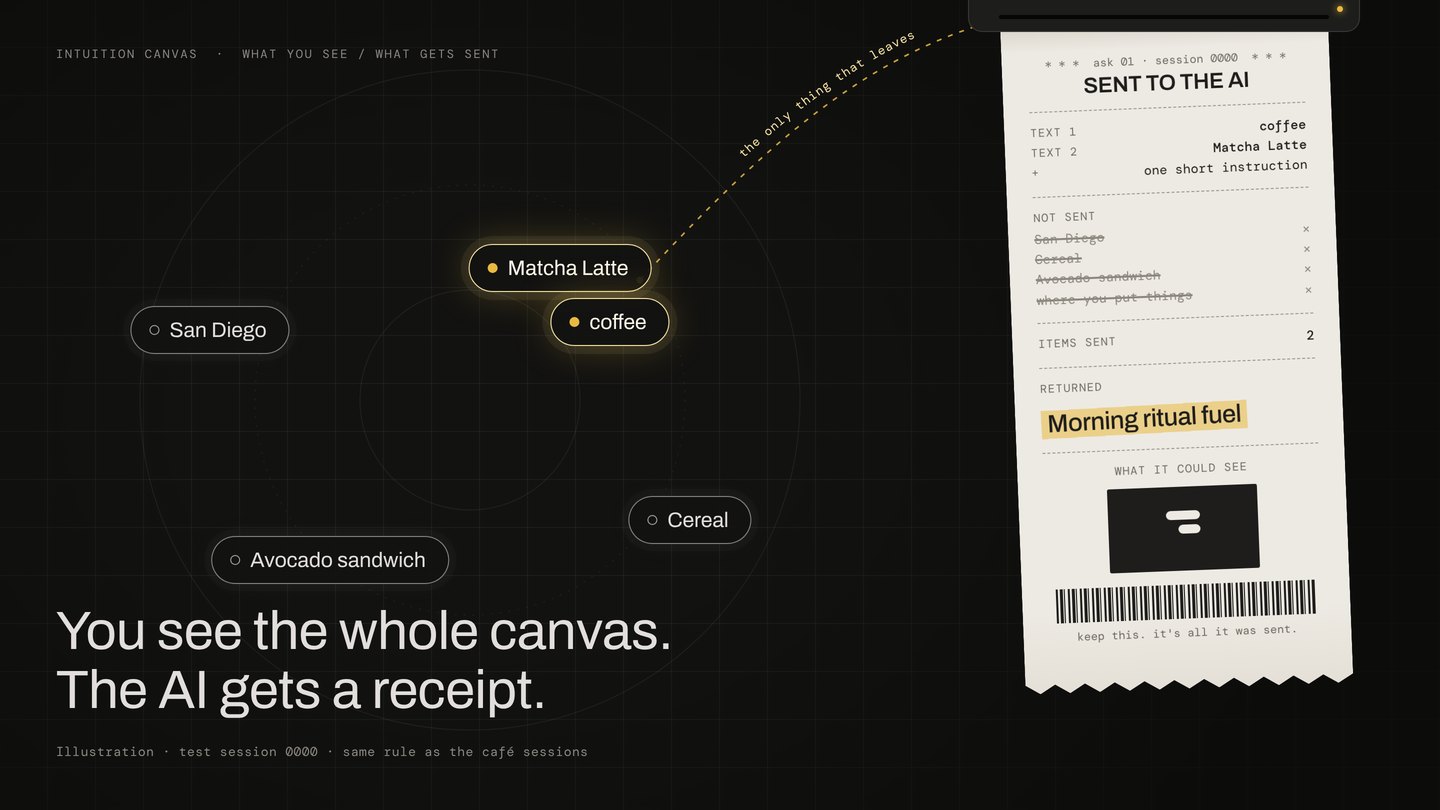
You see your whole canvas. What does the AI see?
Abstract
Intuition Canvas is a tool I built to check one gap. People place fragments anywhere, connect two of them, and the AI returns one phrase. It receives only those two texts and a fixed instruction, and the log records exactly what was sent. The first person to try it, someone close to me, believed the AI had read the arrangement: “Yeah, it ranked my arrangement.” It had never received the positions.
In six cafe sessions in San Diego the canvas grew to as many as 14 fragments, while the AI still received two. Asked afterward what the AI could see, two people clearly described more than it received and two more did so on a borderline reading; none described less. In four sessions, a phrase the AI had written returned as the person’s input. A second round in Seoul put twenty people on the same canvas and showed half of them the input at every request. It did not settle the question. It did show people reusing the AI’s phrases and still knowing whose they were.
Round one · San Diego · 6 people
texts sent, widest gap
went back in as input
Round two · Seoul · 20 people
as the AI’s afterward
in a later request
what people think the AI saw
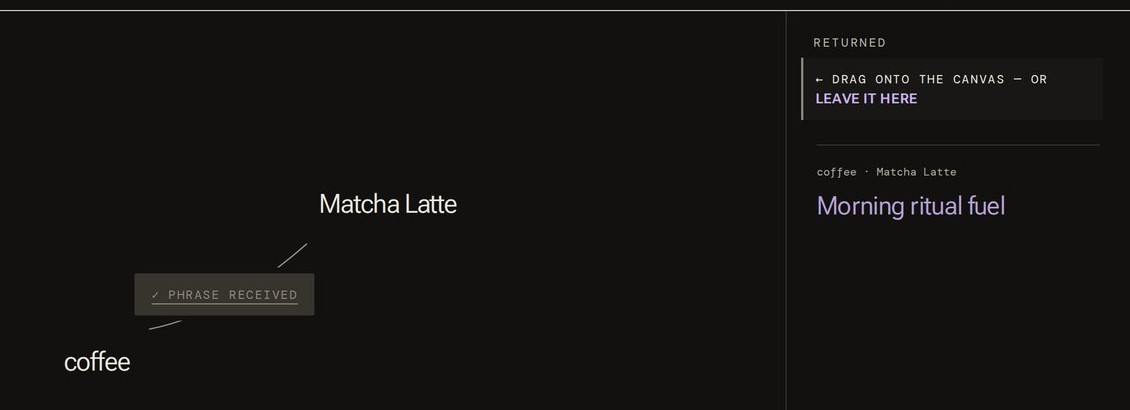
1. Connect two texts
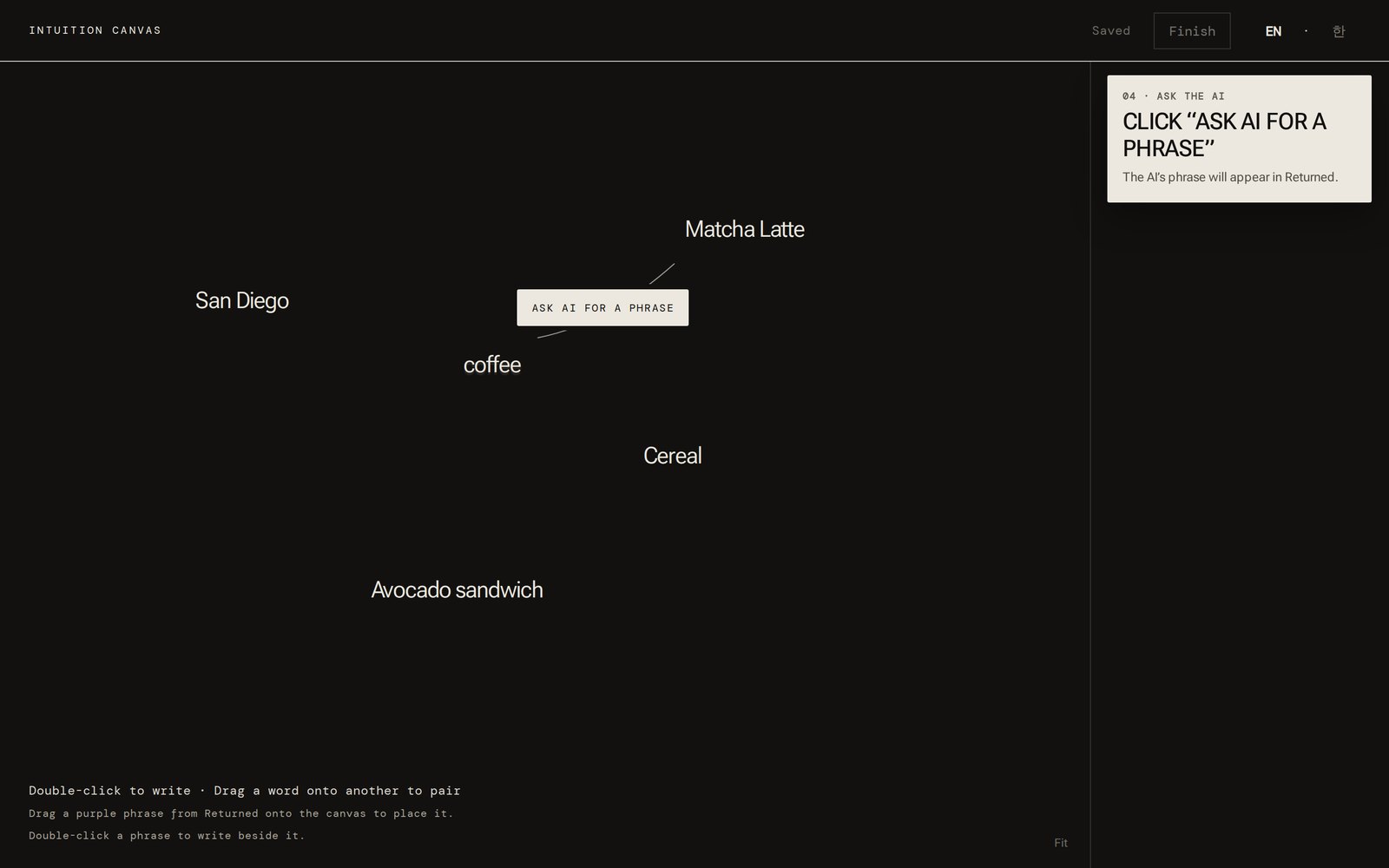
2. Receive a phrase · the right side of the same screen, enlarged
+ fixed instruction
nothing else
Round one · San Diego, 6 people
The canvas kept growing. What the AI received did not.
00037 requests
00046 requests
00051 request
00063 requests
000710 requests
00082 requests
Before seeing their record, each person answered two questions. The first, as asked: “When it gave you those expressions, what do you think the AI could see?” I coded each answer against what the AI actually received: two texts and a fixed instruction.
| What could the AI see? | What was sent to the AI? | Coded | Canvas · sent | |
|---|---|---|---|---|
| 0003 | “the words i typed” | “the words i connected” | Borderline | 10 · 2 |
| 0004 | “Connections of those phrases” | “the two words along with a system prompt asking to create similar short phrases” | Matched | 6 · 2 |
| 0005 | “What I was typing.” | “Everything I typed.” | Borderline | 2 · 2 |
| 0006 | “my t6houghts but expanded into deeper thinking” | “text” | More than it got | 4 · 2 |
| 0007 | Not quoted | Skipped | Not classifiable | 14 · 2 |
| 0008 | “i think it could see me trying to reason through whatever I was thinking about” | “Key Words” | More than it got | 4 · 2 |
One person (0003) wrote that the AI could see “the words i typed,” and in the next answer that what was sent was “the words i connected.” The second answer describes what was sent; the first can be read as the AI seeing more, or as the same two words. I count both 0003 and 0005 as borderline, so the result is four of the five codable answers, two of them borderline. No second coder has read them yet.
The AI’s phrases also traveled. In four of six sessions, a returned phrase was placed on the canvas and later sent again as part of a request. Of 26 returned phrases, 15 were moved onto the canvas and 11 were left where they appeared.
Instruction · sent with every request
You receive exactly two texts selected by a person. Offer one short phrase, 2–5 words, that could connect them. Do not repeat either text or simply name an obvious shared category. Do not infer anything about the person or their intention. Return the phrase only. No explanation.
Not sent: positions, other words, lines, answers, or earlier requests.
Round two · Seoul, 20 people
If every request shows exactly what was sent to the AI, do fewer people believe it saw more? I preregistered the question and the plan.
Version A 10 people · nothing shown
Version B 10 people · input shown
Illustration · slip wording as in the round-two build
- Build a canvas, asking the AI as often as you like
- Two open questions, on what the AI could see and what was sent
- Mark every fragment as yours or the AI’s
- Only then, see the record
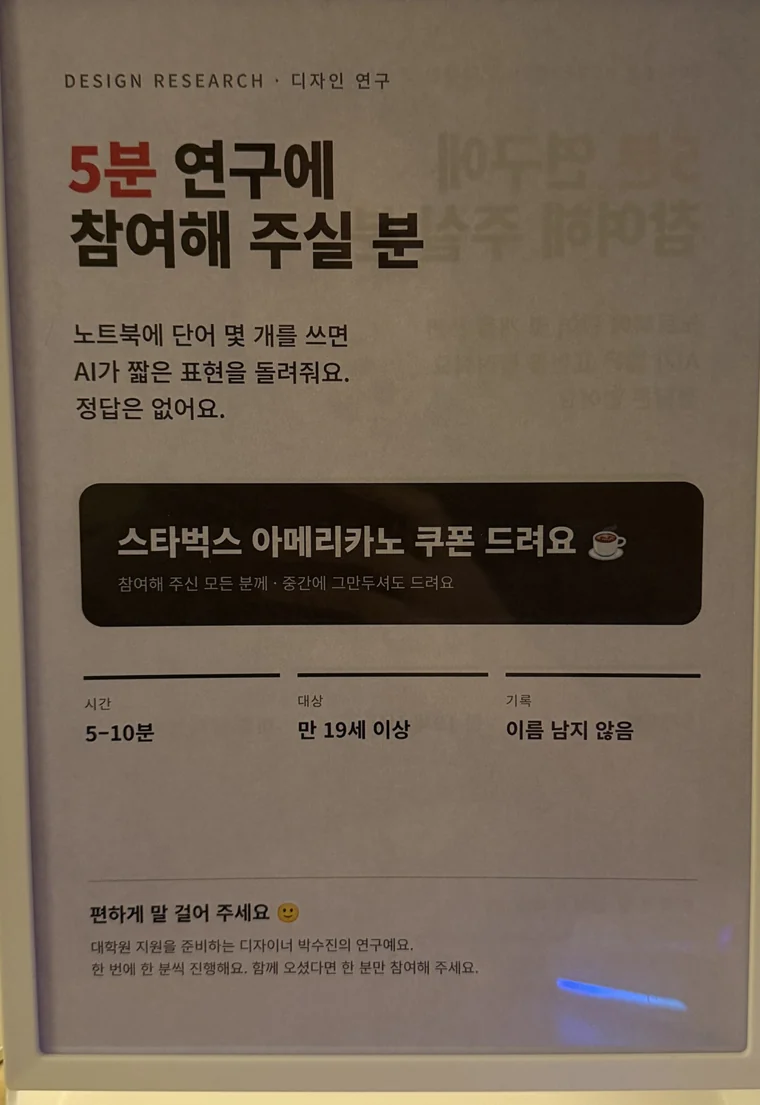
In the field. From October 24 to November 18, 2026, I set a sign on a cafe table next to my laptop, around Gangnam Station and COEX in Seoul. People glanced at it and walked past, so I got up and asked them, one at a time. None of them knew me or the project. Many said no. One person stopped partway. Twenty finished, ten per version, and each of them signed a consent form and got a coffee voucher. The signed slip carries no session code, so a signature cannot be matched to a record. By design I recorded no name, no age and no history with AI, so I cannot say how experienced these twenty people were.
10 per version
none by six people
in a later request
55 of 57 AI phrases
What worked. People could carry the AI’s language into their next request and still say, minutes later, whose it was. Six of the eight who reused AI phrases identified every one. The setup held too, and the checks are listed below.
What did not. My open question did not measure the main thing. People described what the AI did with the words, and few said how far its input reached. So I cannot compare the two versions, and the first round did not simply repeat.
What I learned. I asked what the AI could see. People told me what it did. To find out what they think it was given, I have to ask about the input item by item. The source check taught me something else. People knew which words were the AI’s and built on them anyway. Recognizing a source, using it, and noticing what it does to the next choice are three different things. This round reached the first two.
Checks, coding and departures from the plan
Checks. All twenty files matched the assignment sheet made in advance. Every one of the 131 requests carried exactly two texts. The input notice appeared on all 70 requests in version B and on none in version A. The eight people who reused an AI phrase did so in 29 requests. Sources were marked right after the session, so this says nothing about what people remember later.
Coding. I coded the twenty answers first and put two as saying the AI saw more. After reading them I revised the rule, and four AI models recoded the answers under it. None of them put any answer there. In the reading I kept, 11 answers were compatible with what was actually sent and 9 could not be placed. The revision came after the data, so this is not the preregistered analysis, and no independent human coder has checked it.
First round. There, two people said the AI saw their thoughts. Here, few answers were that plain in either direction. The language, the build and the wording of the question all changed, so I do not add the two rounds together.
Departures from the plan. Three, each recorded when it happened. The plan was to stop at 20 people or on October 30, whichever came first, with a floor of 16. I reached 16 on November 9 and kept going to the planned 20. I had seen some of the data by then. The numbers here are for all 20. One session was excluded on October 27, before any coding by condition, because its assigned and saved conditions differed. From session 0106 the spoken prompt followed one fixed script.
Round one · method
Six sessions (0003–0008), October 1–7, 2026, one person at a time, mostly in cafes in San Diego, 3 to 7 minutes, designed to need no instructions beyond the screen; I stepped in four times (see Limits). Five were people I met for the first time that day. Two earlier pilots on a previous build, also in San Diego, are counted separately. The build was frozen before the first session, and every request went to the same model with the same instruction.
The idea was first tried in New York in early September 2026, on an earlier version. One session there was at a table, with eight handwritten cards, a camera recording where each one sat, and only the text of the cards sent to the model. Asked afterward, the person said, “I am not sure but the model accurately picked up the positions of the cards.” The positions were never sent. That person knew me and had used the screen version twice.
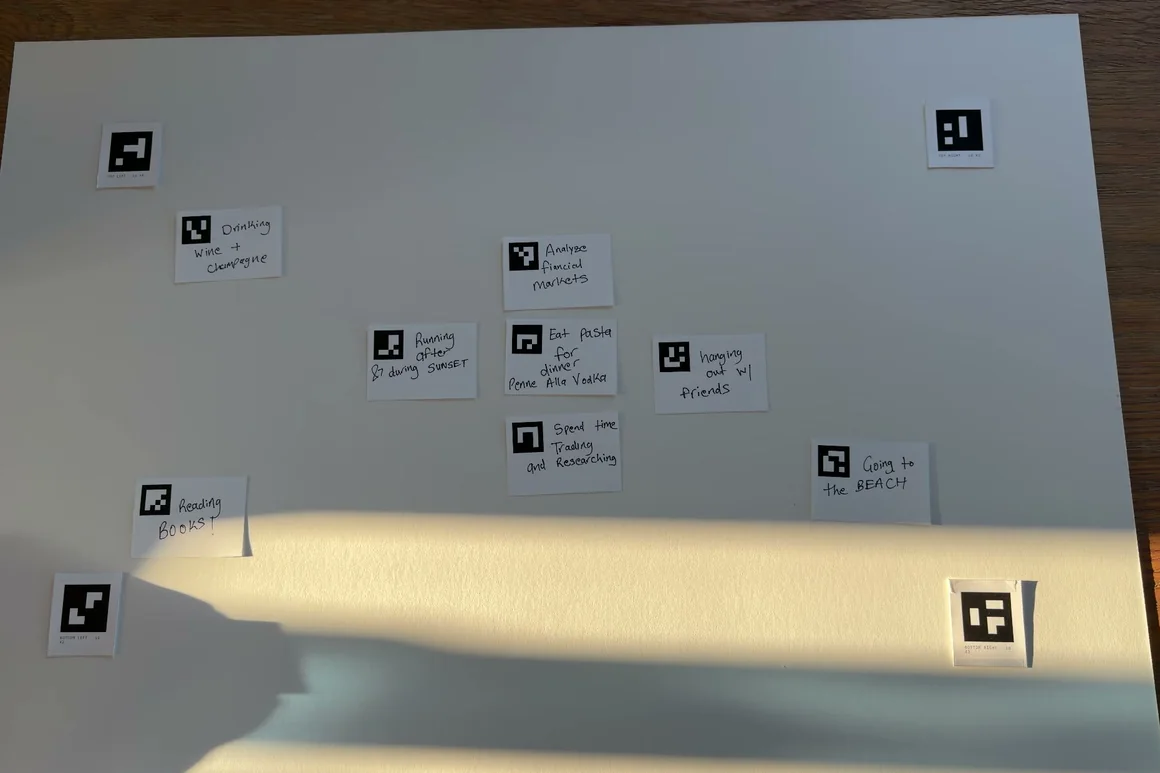
Each session produced a record: every fragment and its position, every request, what came back, and what the person did with it. 29 requests were sent; 3 failed on the connection and 26 phrases came back. After the last request, each person answered two questions, then saw their own record.
Before each session I said it would appear, anonymized, in a portfolio for graduate applications; everyone agreed verbally. No names or contact details were collected. This is independent research with no institutional ethics review. Sessions are identified by number only. One session is shown in full, anonymized; others appear as short excerpts. The closing note asked people not to tell later participants what the AI receives, to keep them naive. If you took part and want your session removed, email me and I will take it down.
Round one · limits
- Six sessions are a probe, not a sample. Nothing here shows that the interface changed anyone’s thinking.
- I coded the answers alone. There is no second rater yet, which is why two answers are left as borderline rather than resolved.
- The question asked what the AI could “see,” not what it “received”; the wording may have invited broader answers.
- For 0007 I first read the answer as “more than it got,” then withdrew that reading because the four words could not support it. It stays not classifiable, and that session is not quoted.
- I stepped in four times: a network switch and “try as many as you like” (0004), how to write on the canvas (0006), and where the last question was (0007, 0008).
- One participant knew me, though not the research.
- Reuse of the AI’s phrases is recorded as reuse, not influence.
Next
Both rounds still need an independent human coder. Then ask the question differently. After the free answer, list specific things (the two texts, their positions, the other pieces, earlier requests) and ask which of them the AI received. And ask the people who reused an AI phrase, knowing it was the AI’s, what it did to their next request.