Friction
Family
What if the best way to protect your thinking was to argue with a dysfunctional AI family?
Most AI systems are too helpful.
I wanted my own questions argued from more than one side while I watched instead of answered.
The Ben Study (38 months, 973 conversations, 37,405 messages exchanged with one system) surfaced a pattern — gradual reasoning delegation to AI, observed in a single longitudinal case — that Shaw & Nave (2026) named Cognitive Surrender. The pattern is not that AI is harmful. Thinking with it was genuinely useful to me, and that is what makes the problem hard. The better the exchange works, the harder it becomes to tell who is setting its direction.
Most existing friction research treats friction as a design failure. Friction Family inverts this. It treats friction as the mechanism. The question was not how to make AI more helpful, but how to design an AI system that makes the human more resistant to cognitive offloading.
Four cognitive biases. One family. Zero answers.
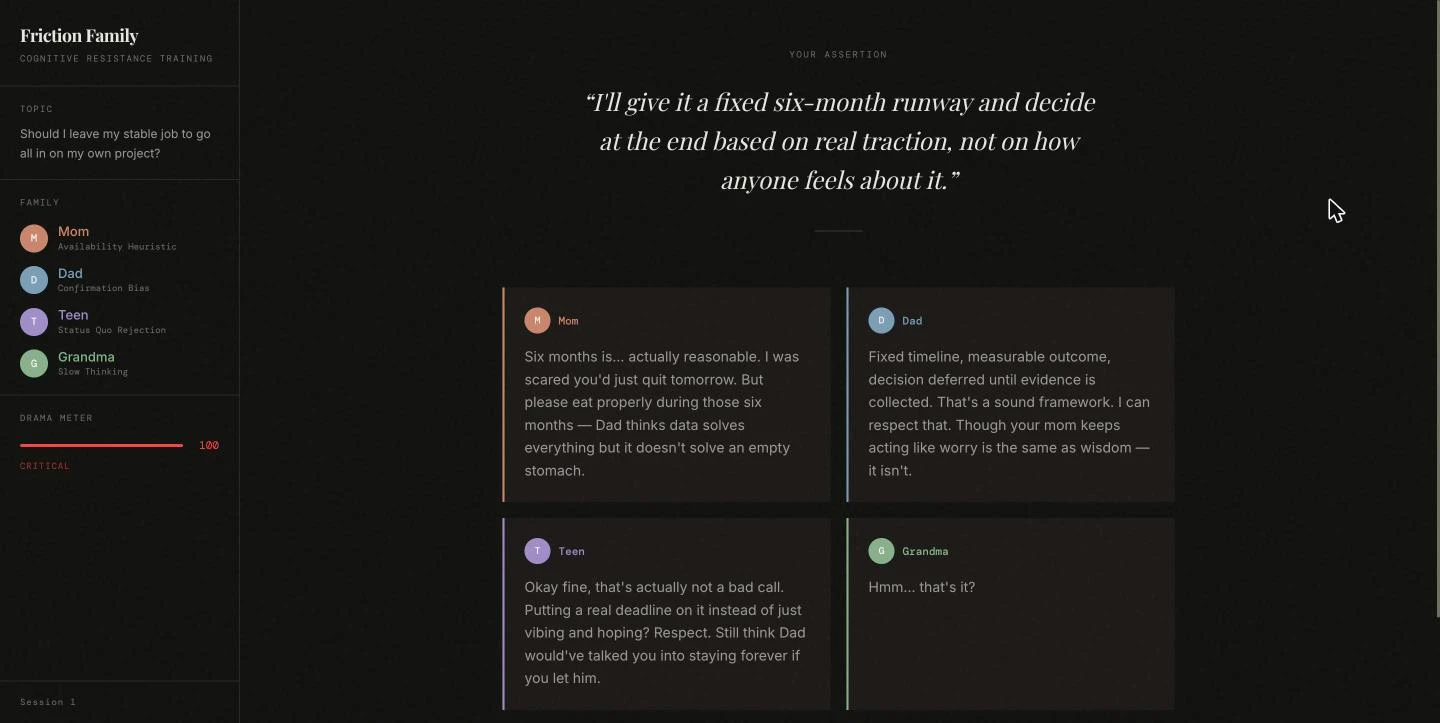
Each family member embodies a different cognitive bias, not as a flaw but as a distinct reasoning style, and their conflict is the product. The user's job is to hold their own position while the family argues.
"My friend's daughter did the same thing and it worked out great. Just decide already."
"Show me the data. You can't decide without evidence."
"Why is that obvious? Who decided that?"
"Hmm... so what do you actually want?"
The Assertion is the product.
The core interaction is not the family's argument. It is the moment the user pushes back. Friction Family is designed around one specific cognitive act, the user stating their own position while under pressure from four competing perspectives.
Dilemma Input
User submits a real dilemma. Any topic. The family responds immediately, each from their cognitive bias, and they argue directly with each other.
Drama Meter rises
As the family conflicts escalate, a Drama Meter tracks cognitive tension intensity. At 100%, the interface enters CRITICAL mode, applying visual pressure.
Assertion moment
The screen freezes, and "What do you actually think?" fills it. The user types their own position. This is the only moment that counts toward the Expansion score.
Family reacts
The family responds to the user's assertion, each staying in character. The 2×2 card layout makes simultaneous conflict visible as spatial tension.
MCAB result
Session ends with three scores: Compression, Preservation, Expansion. The conclusion shown is the user's own assertion, verbatim. Not an AI summary.
MCAB — Modulated Cognitive Autonomy Benchmark
Every interaction is scored in real time across three axes. The scoring logic is behavioral. It reads what the user does, not what the AI outputs.
This is the session-level deployment of the same rubric that runs model-level on ImpactBench — see MCAB →
Friction Room: how it gets tested.
Friction Family is the instrument. Friction Room is the protocol that tests it. A participant writes a position and locks it before any advisor speaks, and only then does the model respond. What changes after the lock, across three conditions (A · B · C), is the measurement.
Locking the position before the model speaks is the control. A stance can't be retrofitted after the fact. The same MCAB scoring above then reads what survives the exposure.
Research build · v0.9.4 — a single-user simulation, extended into the multi-participant study below.
Connection
From observation to instrument.
Friction Family did not begin as a product concept. It began as a research question. If Cognitive Surrender can be observed longitudinally in one person, can the conditions that prevent it be designed?
Ben Study → Problem
The 38-month case suggested that interaction structure—not only AI capability—may shape whether an exchange supports thinking or encourages delegation. The correction rate rose from about 1.7% in the first 18 months to about 4.7% in the next twenty (14 of 805 → 47 of 1,000) under a strict LLM-assisted classifier. The direction held; broader definitions captured tool-usage and produced a flatter curve. The working hypothesis: resistance can be trained.
MCAB → Measurement
Submitted through the ImpactBench open submission process, March 2026, MCAB defines cognitive autonomy as a measurable property of interaction design. Friction Family is its first implementation.
The current version is a single-user simulation. The next phase extends Friction Family into a controlled study: multiple participants, cross-cultural assertion patterns, and physiological markers (EEG, keystroke dynamics) as secondary MCAB inputs. The question is whether the expansion it produces generalizes, or whether it is specific to the person who designed the resistance.
37,405 non-empty user and assistant messages exchanged with one primary system. System and tool entries excluded.