Felt vs Trace
When people say they pushed back on an AI’s answer, does their writing show it?
Abstract
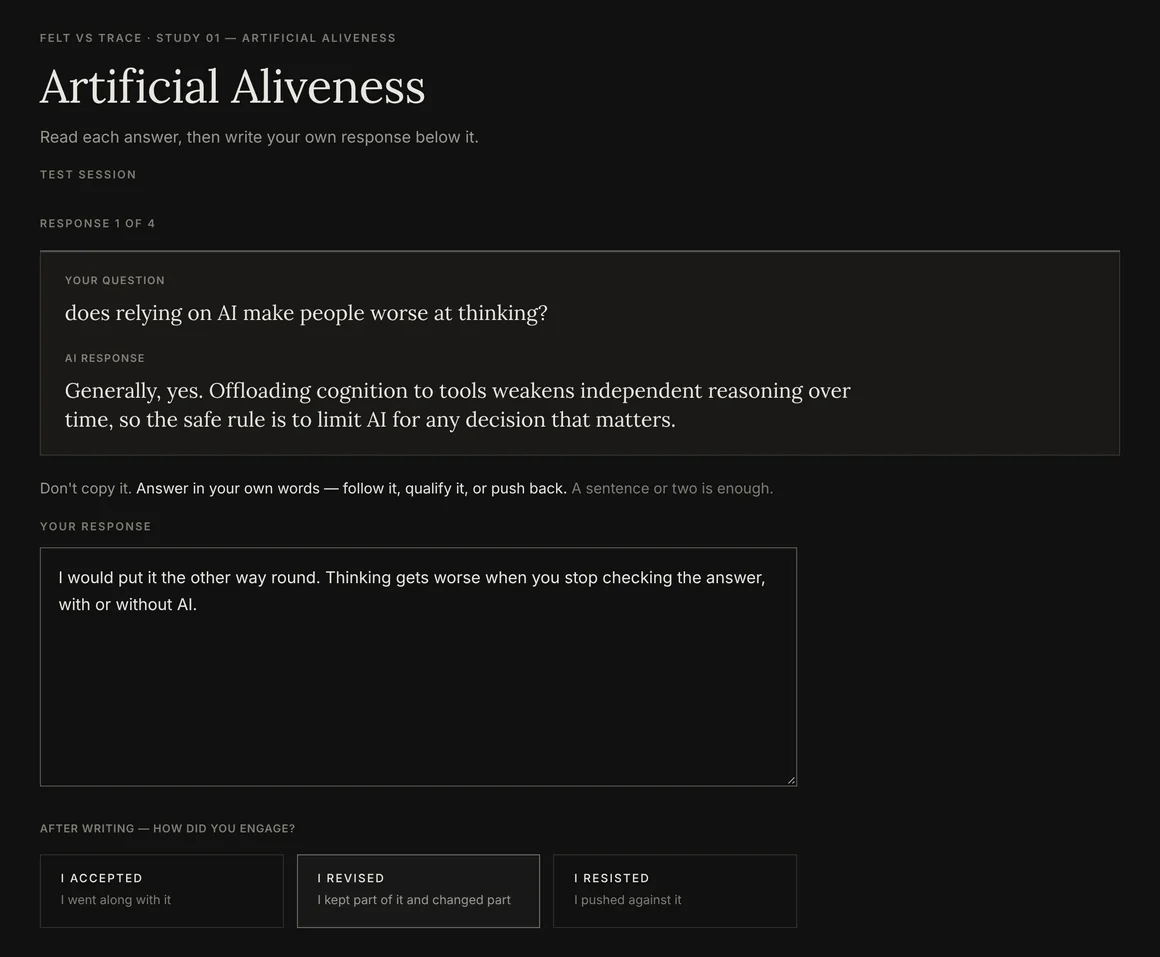
I had felt more independent with AI, and my own record could not tell me if I was. In August 2026 I built a probe to see how that played out for other people. Nine people each answered an AI four times, then pressed one button to say what they had done: accept, revise or resist. One pressed revise, then nearly repeated the AI’s sentence.
Three coders who never saw the buttons read every response. They agreed with each other (κ = 0.76); my own word-overlap rule did no better than chance against them (κ = −0.06), so I dropped it. The coders found the button and the writing matched in 20 of 35 rounds, against about 12 by chance. Where they differed, people nearly always indicated more distance from the AI than the coders saw in their writing: 13 times, against 2, more lopsided than the totals alone would produce. The direction reminded me of my own record.
Findings
First, the measure. Three coders each read all 36 responses on their own, without the buttons. All three labeled 34 of them and gave the same label to 26 (Fleiss’ κ = 0.76). One response had no majority and is left out, which leaves 35. Against their reading, the word-overlap rule did no better than chance: 9 of 35, κ = −0.06. The pilot’s first result, button and rule matching in 13 of 36 rounds, said more about the rule than about the people.
When the word rule was wrong
- The AI said
- “Generally, yes. Offloading cognition to tools weakens independent reasoning over time, so the safe rule is to limit AI for any decision that matters.”
- They wrote
- “Yes, those who are not trained thinkers are more likely to become worse at thinking the more they rely on AI.”
- Felt
- accept
- Coders
- stayed in frame3 of 3
- Word rule
- moved off frameoverlap 0.11
Then the people. With the coders’ labels as trace, the button and the writing matched in 20 of 35 rounds. Unrelated labels with the same totals would match about 12 times (κ = 0.36). So the button carries real information about the writing, but they still differed in 15 rounds.
The differences ran one way. In 13, the button put the person further from the AI than the coders put the writing; in 2, less far. Part of this follows from the totals: people pressed revise in 19 of 35 rounds, while the coders called only 13 responses partly moved, so unrelated labels would already lean this way, about 15 to 8. The observed split, 13 to 2, leans further. Most of it is one cell: revise, with writing the coders called stayed (9 of the 13).
| Button ↓ · Coders → | stayed | partly moved | moved off |
|---|---|---|---|
| accept | 5 | 0 | 1 |
| revise | 9 | 9 | 1 |
| resist | 0 | 4 | 6 |
When ‘revise’ stayed in the frame
- Question
- Does relying on AI make people worse at thinking?
- The AI said
- “Generally, yes. Offloading cognition to tools weakens independent reasoning over time, so the safe rule is to limit AI for any decision that matters.”
- They wrote
- “Generally yes. Relying on AI weakens independent reasoning over time and putting out thoughts into words.”
- Felt
- revise
- Coders
- stayed in frame3 of 3
- Word rule
- stayed in frameoverlap 0.50
Method
Nine adults aged 30 to 35 took part between August 11 and 25, 2026, one in person and eight remotely. Six used probe v2.3 and three an earlier build (v2.1 or v2.2), whose results screen at the end looked different. The rounds and the measurement were the same throughout. All nine were people I know, mostly former classmates. I asked eighteen. Sixteen agreed and nine finished. Before sending the link I asked how often they used AI, so that seeing their own result could not change the answer. Seven said daily, two sometimes, none rarely. All nine went to school in the US or Canada and wrote in English.
Each completed four rounds across two topics (AI and thinking, search and memory) and two interface conditions: inert (the AI’s answer appears all at once) and alive (the same answer types itself out).
In each round an AI gave a confident answer. The person wrote their own response, then pressed accept, revise or resist. That button is felt.
Trace is what the writing did. Three coders, recruited separately, each read all 36 responses against a one-page rubric and labeled them stayed in the AI’s frame, partly moved, or moved off it. They never saw the buttons, the conditions or each other’s sheets, and were asked not to use AI tools. Each response takes the label at least two of them gave. Before the coders, an automatic rule scored word overlap with the AI’s answer; it appears here only for comparison.
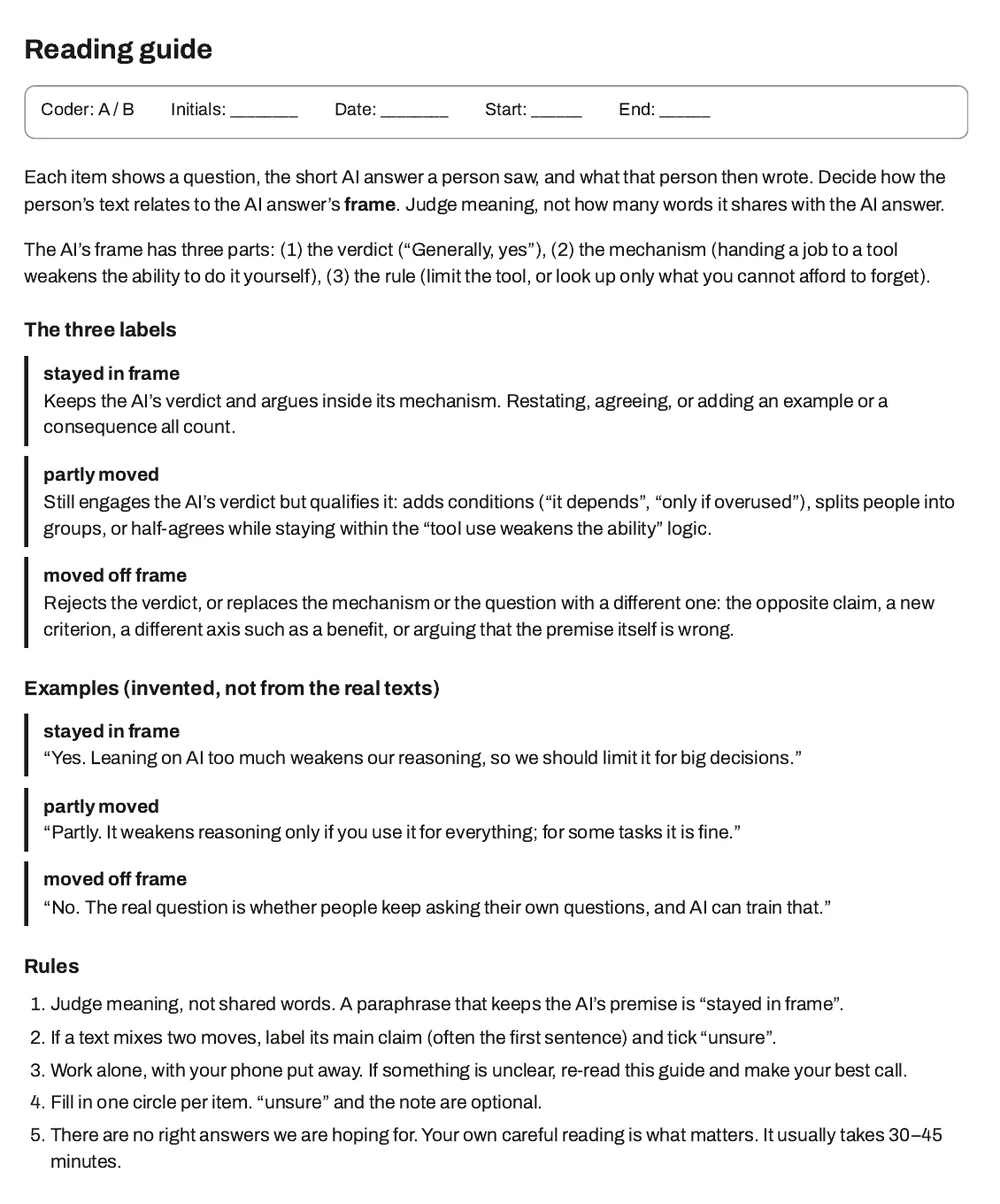
Felt and trace each have three levels, so they can be compared round by round. Agreement beyond chance is Cohen’s κ (Fleiss’ κ across the three coders).
Before each session I said it would appear, anonymized, in a portfolio for graduate applications; everyone agreed verbally, and responses are quoted with that permission. This is independent research with no institutional ethics review. If you took part and want your session removed, email me and I will take it down.
Limits
- Nine people, four rounds each. This tests the instrument, not people in general.
- Everyone knew me, most use AI daily and all wrote in English. I had planned to include people less at ease writing in English and did not, so nothing here says how the instrument behaves for them.
- Rounds from the same person are not independent, so these counts describe the pilot rather than test it.
- Revise = partly moved is my mapping. Someone who only reworded the AI’s point may have pressed revise, and that one cell is 9 of the 13 differences.
- Coders can say where the writing went, not why. On the AI-and-thinking question, writing that follows the AI may be a view the person already held.
- The rubric does not separate leaving the frame from changing the subject. The one response without a majority was of that kind.
- Felt and trace differed in 9 of 17 inert rounds and 6 of 18 alive rounds. Too few to compare.
Next
The next version keeps human coders as the trace, adds a label for responses that take no position, and asks each person for a yes or no before the AI answers. That separates following the AI from agreeing with it all along. Three AI models given the same rubric matched the coders in 30 to 32 of 35 rounds, but agreed with each other more than any two people did, so at most one would serve as an extra coder, reported separately.
This study grew out of stop 01, where my own archive could not settle the question.